


Page Title
Trekking and yoga at Gonggar Mountain Adventure trip
Schedule :From April to October every year
We need your 30% deposit for the booking fee
Tour: Trekking and yoga at Mount Gongga – King of Sichuan Mountains
Duration: 10 Days
Average daily itinerary: 07:00 wake up yoga meditation 08:30 breakfast, explore the village on foot 12:30 lunch 14:00 free time 19:00 dinner 21:30 meditation yoga, rest
Price :7880 rmb per person , 10 people limited. minimum 2 people starts from
费用:7880元每人, 10人以内。
需携带的物品
Need to be prepared by each participant - Hiking shoes (necessary, paths are very slippery when wet) 徒步鞋
- Hiking Jacket & Pants 徒步衣裤 - Quick dry sports gear 速干衣裤 - Rain coat 雨衣 - Warm layers (depending on season: wind breaker, gloves & hat) 保暖层(防风衣,手套和帽子)
- Drinking bottle (no soft bottles because refill is often with boiled water) 水瓶 (非塑料) - Small bag to carry your things during the day 便于携带的袋子 - Hiking Poles (optional, helpful with wet path and to avoid knee problems) 登山杖 (可选择的) - Head lamp (optional) 照明灯(可选择的) - Personal toiletries and towel 毛巾和个人洗漱用品 - Small snacks 小零食
-Small gifts 小礼物
Fee Included:
- Land transportation once in Chengdu (from & back to Chengdu)
- Insurance - Meals as per itinerary - Guiding & Coaching - Accommodation
包含: 成都开始成都结束的行程内所有费用:
交通,餐费,公共设施,保险.
Destination: Sichuan
Activities: Trekking
Route: Chengdu- -Khangding-Chengdu
Attractions: Mt. Gongga, Hengduan Mountains, Luding Bridge, Da Caoba (King Gesar’s grassland), Shuangcha River, Gongga Temple (Minya Konka Gompa)
Highlights:
Rising to a height of 7,556 meters (24,784 feet), Mt. Gongga towers above all the other mountains of Sichuan Province, thus earning it the moniker, “King of Sichuan Mountains.” This 10-day high-altitude trek not only provides breathtaking views, but also allows us time to explore the traditional Tibetan lifestyle of this area.
Towering to a height of 7,556 meters (24,784 feet), Mt. Gongga in western Sichuan Province offers stunning scenery, an abundance of beautiful plants and wildflowers, rich Tibetan culture, and of course spectacular trekking routes. Known as the “King of Sichuan Mountains”, Mt. Gongga is situated in the rugged, seldom visited western part of Sichuan Province, within the Tibetan cultural sphere. Over the course of this 12-day trek, Tibetan guides lead us across three passes over 4,420 meters (14,498 feet), and through a variety of alpine terrains with lakes and meadows. We stop in Tibetan homes and share butter tea and tsampa with our hosts. The climax of the trip will be our visit to Gongga Temple, which in times past produced many famous lamas.
The preferred months for this trek are May, August, September, and October, when there is little rain and the mountain views are clearest. In May you have the added bonus of rhododendrons in bloom. You may also visit during the rainy season in July, when you can see wildflowers spreading over grasslands everywhere, but clouds may obscure your views of the high mountains, and you should be prepared to be wet.
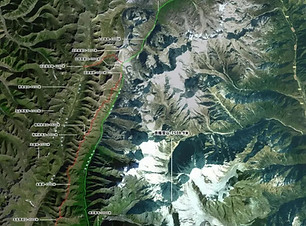
However, more than half of the traditional Gongga Grand Loop (or Gongga Grand Kora) route is traversed through valleys, offering limited views. The biggest drawback is the inability to fully appreciate the majestic presence of Gongga's main peak. During the peak season from June to October, the Moxi Valley, which occupies more than half the route, is highly likely to be shrouded in a sea of clouds. Hikers, situated at the bottom of this cloud formation, often encounter fog and rain, suffering not only from the obstruction of scenery but also from the harsh weather. We abandoned the flat pastoral trails at the bottom of the Moxi Valley and instead hiked along the rugged, undulating ridges. Along the way, we were accompanied by the Gongga main peak group, offering stunning scenery but also a greater challenge.
"Route Innovation" 1. Abandoning the traditional entrance to the mountain—Laoyulin Village, we choose Shangmuju Village instead, and the starting point of the hike is Zimei Pass at an altitude of 4650 meters. This reduces the altitude climb and thus lowers the difficulty of the initial hike, allowing the body more time to adjust before it is fully acclimatized to the high altitude;
2. Before the official start of the hike, we arrange to enjoy the sunset at Yuzixi and a light hike on Lenggacuo Lake, leaving ample time for altitude acclimatization, reducing the chance of altitude sickness, and increasing the opportunity to appreciate the scenery of Gongga from various angles;
3. The first five campsites are all at an altitude of approximately 4500 meters, which is extremely high. The probability of altitude sickness among team members is not small. For light-packed commercial activities, considering the physical condition, stamina, and altitude acclimatization of most participants, an average daily march of about 12 kilometers is more scientifically reasonable.
4. The section from Zimei Pass to Ridaman Pass is the most scenic part of the entire route. When the weather is good, you can enjoy magnificent scenery from every angle.
5. The longest and most difficult day of the entire trip is the seventh day (Xirexie Pass - transition camp). Considering that the team has already hiked at high altitude for 5 days and their bodies have basically adapted to the high-altitude environment, it is believed that most teammates can successfully complete the hike today. Of course, if some teammates are physically weak or have unexpected physical conditions, the leader will handle the situation accordingly and arrange for them to ride horses to the camp or descend in advance.
6. There are more than ten mountain passes on this hiking route where emergency descents can be arranged. It only takes 2-3 hours to reach the road. In case of emergency, horseback riding can be arranged to reach the road in 1-2 hours. Satellite phone can be used to handle emergencies of individual members to the greatest extent possible.
7. The hiking section from Zimei Pass to Ridaman Ranch is 50 kilometers long, with a total elevation gain of 2310 meters and a descent of 2700 meters.
Day 1: Chengdu
The program begins this afternoon when the tour leader thoroughly briefs us on the trip itinerary. After that, we go to a restaurant to sample the delicious and spicy cuisine for which Chengdu is famous. After dinner, we have time for any last minute shopping we need to do in preparation for the trek ahead.
Day 2: Chengdu—Yuzixi—Xinduqiao After breakfast, depart from Chengdu and drive over the 4296-meter-high Zheduo Mountain to Xinduqiao. Check into the hotel first, then drive to Yuzixi to enjoy the beautiful sunset. After descending the mountain, return to the hotel for dinner and rest. Driving distance: Approximately 390km, about 6 hours. Hiking: None. Altitude: Accommodation altitude 3450m. Breakfast: Hotel breakfast. Lunch: None. Dinner: None. Accommodation: Xinduqiao Hotel.
Day 3: Xinduqiao – Lenggacuo – Shangmuju After breakfast, depart from Xinduqiao and head to the Shangmuju Tibetan Guesthouse for overnight stay. At noon, travel to Bangmujide for a hike up the mountain to enjoy the stunning scenery of Lenggacuo Lake and witness the golden sunset over the Gongga Snow Mountain range and its reflections. Descend the mountain in the evening, led by the tour leader, and return to the Shangmuju Guesthouse. Note: Due to the significant temperature difference between day and night, please prepare sufficient warm clothing before departure. Those descending the mountain after watching the sunset must bring a headlamp. Travel Time: Approximately 160km, about 3 hours. Hiking: 7km. Altitude: Accommodation altitude 3750m, cumulative elevation gain 500m, cumulative elevation loss 500m. Breakfast: Hotel breakfast. Lunch: None (please bring your own packed lunch).Dinner: None; Accommodation: Standard room at Shangmuju Inn
Day 4: Shangmuju – Zimei Pass – Yulong West Pass. After breakfast today, we will depart by car to Zimei Pass, officially beginning our trek along the Gongga Mountain ridge. We will be surrounded by the main peaks of Gongga Mountain. In the afternoon, we will arrive near Yulong West Pass and set up camp to watch the sunset and starry sky. Trekking: 8km. Altitude: Accommodation altitude 4650m, cumulative elevation gain 440m, cumulative elevation loss 490m. Breakfast: Hotel breakfast. Lunch: None (bring your own packed lunch). Dinner: Dinner at the campsite. Accommodation: Camping (2 people/camp, bring your own sleeping bag).
Day 5: Yulong West Pass – Zuoruo Lake Campsite. After breakfast, depart for Zuoruo Lake, the closest small lake to Gongga Mountain where you can photograph its reflection. However, the lake is very small and only has water from July to early November, making it a seasonal lake. Hiking: 7km climb. Altitude: Accommodation altitude 4500m, cumulative ascent 370m, cumulative descent 490m. Breakfast: Campsite breakfast. Lunch: None (bring your own packed lunch). Dinner: Campsite dinner. Accommodation: Camping (2 people/camp, bring your own sleeping bag).
Day 6: Zuoruo Lake—Xirexie Pass/Haizi Today is another day spent with the main peaks of Gongga Mountain. We'll hike and explore at our own pace. In the afternoon, we'll arrive at Xirexie Pass and set up camp. Depending on the situation, we'll choose to camp at the pass or descend to Xirexie Lake. Since there's no water source at the pass, we'll need to bring water by pack animals, which can be difficult in some seasons. Hiking: 10km ascent/hiking Altitude: Accommodation altitude 4670m, cumulative ascent 500m, cumulative descent 330m Breakfast: Camp breakfast Lunch: None (bring your own packed lunch) Dinner: Camp dinner Accommodation: Camping (2 people/camp, bring your own sleeping bag)
Day 7: Xirexie Pass/Haizi—Transition Camp Today's journey is from Xirexie Pass to the transition camp below Riwuqie Pass. This is the most difficult and strenuous day, so the leader will plan the time accordingly. Hiking: 14km ascent/hiking Altitude: Accommodation altitude 4600m, cumulative ascent 450m, cumulative descent 520m Breakfast: Camp breakfast Lunch: None (bring your own packed lunch) Dinner: Camp dinner Accommodation: Camping (2 people/camp, bring your own sleeping bag)
Day 8: Transition Camp – Riwuqie Pass – Ridaman Pass – Ridaman Pasture – Xinduqiao Today, we depart from the transition camp, crossing the 4900-meter Riwuqie Pass. Then, we traverse from the 4800-meter platform north of the pass towards the Ridaman Pass, followed by crossing the 4950-meter Ridaman Pass. We descend to Ridaman Pasture and then transfer to a hotel in Xinduqiao for overnight stay. Enjoy a hot shower and a celebratory dinner. Hiking: 10km Altitude: Accommodation altitude 3450m, cumulative elevation gain 550m, cumulative elevation loss 870m Breakfast: Camp breakfast Lunch: None (bring your own packed lunch) Dinner: None Accommodation: Xinduqiao Hotel
Day 9: Xinduqiao—Kangding 2,765 meters (9,069 feet)
This morning, our 4WD vehicles pick up us, and we drive back Kangding via Liuba and Xinduqiao. We drive about 8 hours through the countryside, dotted with picturesque Tibetan villages. We arrive in Kangding in the late afternoon and check into our hotel. After cleaning up, we have a sumptuous Sichuan meal-our first dinner in ten days not cooked over a camp stove.
Day 10: Chengdu
Kangding—Chengdu Today, return to Chengdu by car. Airport transfer will be arranged at Shuangliu Airport, followed by transfer to the designated hotel in Chengdu city. You can choose a suitable drop-off point based on your flight schedule (choose one). Note: Considering potential traffic congestion and other unforeseen circumstances, it is recommended to book your main transportation out of Chengdu for the following day. Travel time: Approximately 390km, about 6 hours. Breakfast: Hotel breakfast. Lunch: None. Dinner: None. Accommodation: None (can be booked if needed).
Hotel accommodation inclusive in the above package:
Meal Code: B-Breakfast in the hotel L-Chinese lunch in local restaurant D-Chinese Dinner in local restaurant
Group Size minimum 2, maximum 12
Price (Per Pax in US$):
Tour leader:Jolie with the local guide
Remark:
* Please also note: this itinerary is subject to change.
* We will change the price follow the market, and we make sure by e-mail.
* The above quotation is based on twin share. Single supplement will be charged only when you are the 3rd, 5th person in this group, and need to stay in one single room, which means no one in the group can share the cost of accommodation with you.
The Package Includes:
Average daily itinerary: 07:00 wake up yoga meditation 08:30 breakfast, explore the village on foot 12:30 lunch 14:00 free time 19:00 dinner 21:30 meditation yoga, rest
* Daily private escorted tours with all entrance fees in the itinerary.
* All meals as specified in the itinerary “B” stands for Breakfast, “L” for Chinese Lunch. “D” for Chinese dinner in local Chinese restaurant. The Package include the 6 breakfast and 13 meals.
* Service of English speaking tour guide during all transfers and sightseeing
* Local transfers by company vehicle.
* Hotel accommodation based on twin share
* All local tax.
The Package is Not Inclusive of:
* Airline tickets or train tickets
* Insurance
* All optional programs;
* Meals: Any meals which are not specified with “B”, “L”, or “D”;
* Personal expenses and gratuities to service staff.
Due to the road conditions, weather and availability of room, Minor program changes sometimes are necessary, all above is subjected to our confirmation.
Health and Safety
We will ensure customers are provided with hygienic food and accommodation.
All participants with a medical condition requiring treatment or which may be affected by strenuous activity or altitude, heat, cold or particular foods must notify the company in writing in advance.
Some trips require a high level of fitness. In this case, participants will be required to submit a medical and physical examination record. The company’s or tour leader’s judgment shall provide the final determination of an individual’s fitness to embark upon, or continue with a trip.
All participants must be covered by a valid medical and travel insurance policy for the duration of the trip.
Physical conditioning is recommended as preparation for all trips, especially those involving trekking and cycling.

Small Title
yaks
Small Title
Tibetan woman

Small Title
Mountain Minya Kongka